

Use Real IIA Achieve the IIA-CIA-Part3 Dumps - 100% Exam Passing Guarantee
Verified IIA-CIA-Part3 Q&As - Pass Guarantee IIA-CIA-Part3 Exam Dumps
Things You Should Know about the IIA CIA Part 3 Exam
The IIA CIA Part 3 course is designed to help you pass the Part 3 exam in just two days. The course focuses on all the major topics that you need to be familiar with in order to pass the test.
It is important to keep in mind that while you are taking your test it is a good idea to take a break and relax as much as possible. Taking a break will help keep your mind off of how much time has passed since you last took a test. It also gives you an opportunity to get back on track and focus on what you are doing.
If you want to know more about our training programs and some of the other things that we offer then please visit our website. You can learn more about the different kinds of tests that we offer and the many types of training materials that we have available for your use. IIA CIA Part 3 exam dumps will help you prepare for the exam, and also help you to get the best score possible. We also offer free practice exams so that you can see if our training program is right for you.
NEW QUESTION 34
Which of the following pricing policies involves the selling company setting freight charges to customers at the actual average freight cost?
- A. FOB-origin pricing.
- B. Uniform delivered pricing.
- C. Zone pricing.
- D. Freight absorption pricing.
Answer: B
Explanation:
In uniform delivered pricing, the company charges the same price, inclusive of shipping costs, to all customers, regardless of their location. This price is the company's average actual freight cost. Thus, both nearby and distant customers are charged the same amount. This policy is easy to administer, permits the company to advertise one price nationwide And facilitates marketing to faraway customers.
NEW QUESTION 35
In which of the following organizational structures does total quality management TOM) work best?
- A. Teams of people from the same specialty.
- B. Teams of people from different specialties.
- C. Specialists working individually.
- D. Hierarchal.
Answer: B
Explanation:
TOM advocates replacement of the traditional hierarchal structure with teams of people from different specialties. This change follows from TQM's emphasis on empowering employees and teamwork. Employees should have proper training, necessary information, and the best tools; be fully engaged in the decision process; and receive fair compensation. If such empowered employees are assembled in teams of individuals with the required skills, TOM theorists believe they will be more effective than people performing their tasks separately in a rigid structure.
NEW QUESTION 36
According to the COSO enterprise risk management (ERM) framework, which of the following is not a typical responsibility of the chief risk officer?
- A. Defining ERM roles and responsibilities.
- B. Establishing risk category definitions and a common risk language for likelihood and impact measures.
- C. Providing the board with an independent, objective risk perspective on financial reporting.
- D. Guiding integration of ERM with other management activities.
Answer: C
NEW QUESTION 37
Which of the following disaster recovery plans includes recovery resources available at the site, but they may need to be configured to support the production system?
- A. Hot site recovery plan.
- B. Cool site recovery plan.
- C. Cold site recovery plan.
- D. Warm site recovery plan.
Answer: D
NEW QUESTION 38
Auditors often make use of computer programs that perform routine processing functions, such as sorting and merging. These programs are made available by computer companies and others and are specifically referred to:
- A. User programs.
- B. Utility programs.
- C. Compiler programs.
- D. Supervisory programs.
Answer: B
Explanation:
Utility programs are provided by manufacturers of equipment to perform routine processing tasks required by both clients and auditors, such as extracting data, sorting, merging, and copying. Utility programs are pretested, are independent of the client's own programming efforts, and furnish useful information without the trouble of writing special programs for the engagement.
NEW QUESTION 39
An internal audit activity is piloting a data analytics model, which aims to identify anomalies in payments to vendors and potential fraud indicators Which of the following would be the most appropriate criteria for assessing the success of the piloted model?
- A. The development and maintenance costs associated with the model
- B. The feedback of auditors involved with developing the model
- C. The percentage of cases flagged by the model and confirmed as positives.
- D. The number of criminal investigations initiated based on the outcomes of the model
Answer: A
NEW QUESTION 40
Refer to the exhibit.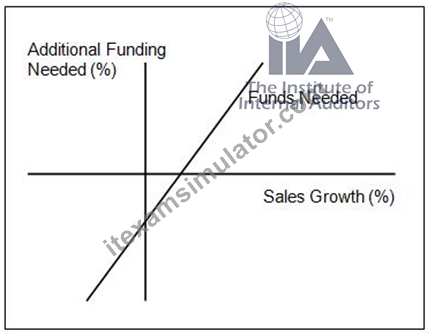
If the profit margin of an organization decreases, and all else remains equal, which of the following describes how the "Funds Needed" line in the graph below will shift?
- A. The "Funds Needed" line will point downward with a minimal slope.
- B. The "Funds Needed" line will remain pointed upward, but will become less steep.
- C. The "Funds Needed" line will remain pointed upward, but will become more steep.
- D. The "Funds Needed" line will point downward with an extreme slope.
Answer: C
NEW QUESTION 41
An organization with an annual demand of 25.000 units correctly computes its economic order quantity to be 1,000 units Its safety stock is 300 units and the lead time is two days If there are 250 production days in a year what is the reorder point1?
- A. 300 units.
- B. 500 units.
- C. 1,000 units.
- D. 200 units.
Answer: B
NEW QUESTION 42
A company services office equipment. Some customers bring their equipment to the company's service shop; other customers prefer to have the company's service personnel come to their offices to repair their equipment. The most appropriate costing method for the company is:
- A. An operation costing system.
- B. A process costing system.
- C. An activity-based costing system.
- D. A job-order costing system.
Answer: D
Explanation:
Job-order costing systems are designed to accumulate costs for tasks or projects that are unique and non repetitive. Service organizations are interested in identifying the costs applicable to each customer and/or each serum.
NEW QUESTION 43
Assuming an available-for-sale financial asset that is not part of a hedge is remeasured to fair value at the balance sheet, the gain or loss not arising from foreign exchange transactions or impairment:
- A. Must be recognized directly in equity.
- B. Must be recognized in profit or loss if the result is a loss and directly in equity if the result is a gain.
- C. May be recognized in profit or loss or directly in equity.
- D. Must be recognized in profit or loss.
Answer: A
Explanation:
A gain or loss on an available-for-sale financial asset that is not part of a hedge is recognized directly in equity through the statement of changes in equity except for impairment losses and foreign exchange gains and losses. The accumulated remeasurement gain or loss is included in profit or loss when the asset is derecognized.
NEW QUESTION 44
COBIT is targeted at all of the following except:
- A. Shareholders.
- B. Management.
- C. Users.
- D. Auditors.
Answer: A
Explanation:
COBIT is targeted at three distinct audiences: management, users, and auditors. Management must balance risks and control costs in the volatile IT environment. Users need assurance about the security of, and controls over, internal or third-parry IT services. Auditors must be able to support their opinions conveyed to management and others about the state of internal control. Because shareholders are not directly involved with IT services used in the day-to-day management of an organization, they are not a targeted audience of COBIT.
NEW QUESTION 45
Which of the following recognized competitive strategies focuses on gaining efficiencies?
- A. Focus
- B. Cost leadership
- C. Differentiation
- D. Innovation
Answer: B
NEW QUESTION 46
According to IIA guidance, which of the following best describes an adequate management (audit.) trail application control for the general ledger?
- A. Report identifying data that is outside of system parameters
- B. Report identifying general ledger transactions by time and individual.
- C. Report comparing processing results with original Input
- D. Report confirming that the general ledger data was processed without error
Answer: B
NEW QUESTION 47
The first stage in the development of a crisis management program is to:
- A. Conduct a risk analysis.
- B. Create a crisis management team.
- C. Practice the response to a crisis.
- D. Formulate contingency plans.
Answer: A
NEW QUESTION 48
A clothing company sells shirts for $8 per shirt. In order to break even, the company must sell 25.000 shirts. Actual sales total S300.000. What is margin of safety sales for the company?
- A. $200,000
- B. $500,000
- C. $100.000
- D. $275,000
Answer: C
NEW QUESTION 49
What must be monitored in order to manage risk of consumer product inventory obsolescence?
1.Inventory balances. 2.Market share forecasts. 3.Sales returns. 4.Sales trends.
- A. 1 only
- B. 1 and 4 only
- C. 1, 2, and 3 only
- D. 4 only
Answer: B
NEW QUESTION 50
In mergers and acquisitions, which of the following is an example of a horizontal combination?
- A. Dairy manufacturing company taking over a large dairy farm.
- B. A baker taking over a competitor.
- C. A movie producer acquires movie theaters.
- D. A petroleum processing company acquires an agro-processing firm.
Answer: B
NEW QUESTION 51
Enterprise-wide resource planning ERP) software packages, such as SAP and Oracle, are all-inclusive systems that attempt to provide entity-wide information. ERP systems provide
advantages to the auditor because they:
- A. Typically have built-in transaction logs and the ability to produce a variety of diagnostic reports.
- B. Typically require firms to reduce the division of duties and responsibilities found in traditional systems.
- C. Have proven difficult for some firms to install.
- D. Have been installed by smaller firms so, to date, few auditors have encountered them.
Answer: A
Explanation:
ERP systems have a variety of controls and report generation functions that allow the auditor to abstract and monitor data collected and processed. Some ERP systems have built-in audit functions.
NEW QUESTION 52
Data regarding four different products manufactured by an organization are presented as follows. Direct material and direct labor are readily available from the respective resource markets. However, the manufacturer is limited to a maximum of 3.000 machine hours per month.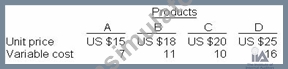
Units Produced per Machine Hour:
- A. 3 The product that is the most profitable for the manufacturer in this situation is
- B. 0
- C. Product D
- D. Product A
- E. 1
- F. 2
- G. Product C
- H. Product B
Answer: F
Explanation:
When resources are limited, maximum profits achieved by maximizing the dollar contribution margin per limited or constraining factor. In this situation, machine hours are the constraining factor. Product B has a contribution margin per machine hour of US $28 [4 x (US $18 - $11)], which is greater than that of Product A [3 x (US $15 - $7) = US $24], Product C [2 x (US $20 - $10) = US $20] or Product D [3 x (US $25 - $16) = US $27].
NEW QUESTION 53
For control purposes, which of the following should be organizationally segregated from the computer operations function?
- A. Surveillance of screen display messages.
- B. Systems development.
- C. Minor maintenance according to a schedule.
- D. Data conversion.
Answer: B
Explanation:
Systems development is performed by systems analysts and application programmers.
NEW QUESTION 54
A retail entity maintains a markup of 25 % based on cost. The entity has the following information for the current year:
Beginning inventory was:
- A. US $265,000
- B. US $85,000
- C. US $110,000
- D. US $40,000
Answer: B
Explanation:
Cost of goods sold equals beginning inventory, plus purchases including freight-in minus ending inventory. Given that sales reflect 125% of cost, cost of goods sold must equal US $720,000$900.000 sales Consequently the beginning inventory must been US $85,000$720,000 CGS $80,000 E- $690,000 purchases - $25,000 freight-in)
NEW QUESTION 55
......
Check the Free demo of our IIA-CIA-Part3 Exam Dumps with 265 Questions: https://torrentlabs.itexamsimulator.com/IIA-CIA-Part3-brain-dumps.html
