

Free 1z0-1065-25 Exam Files Downloaded Instantly UPDATED [2026]
100% Pass Guaranteed Free 1z0-1065-25 Exam Dumps
NEW QUESTION # 43
Your customer has been reviewing previous negotiations and now wants to be able to evaluate supplier responses on more than just price.
Which other option can be used, together with price, to determine the supplier offer?
- A. External cost factors
- B. Qualitative aspects
- C. Supplier eligibility
- D. Internal cost factors
Answer: B
NEW QUESTION # 44
Which seeded role must be associated with a supplier user account for the supplier to be able to respond to invited negotiations?
- A. Supplier Contract Manager
- B. Supplier Bidder
- C. Supplier Self Service Administrator
- D. Supplier Customer Service Representative
- E. Supplier Sales Representative
Answer: B
Explanation:
The seeded role that must be associated with a supplier user account for the supplier to be able to respond to invited negotiations is Supplier Bidder. This role grants the supplier user the ability to view and respond to negotiations, create and manage responses, and view award decisions. The other roles are not relevant for this purpose.
:
Supplier Administrator (Abstract Role) - Oracle, section "Supplier Bidder (Abstract Role)".
Set Up Supplier Roles - Oracle, section "Supplier Bidder Role".
NEW QUESTION # 45
In relation to suppliers, your client has several suppliers with whom they expect to do a high volume of business over an extender period. To simplify this, it would be useful to use master contracts to set the overall terms and conditions between parties.
Which two purchasing documents can link to this type of contract?
- A. Negotiations
- B. Requisitions
- C. Agreements
- D. Purchase Orders
- E. Initiatives
Answer: C,D
NEW QUESTION # 46
You are using the Responsive Self Service Procurement application and you want to review the list of current approvers of a requisition pending approval, but these are not displayed.
Which two could be reasons for the approvals not being displayed?
- A. Only the approvers can view the list of approvers.
- B. There are errors in retrieving approval details, or there could be any other infrastructure issues.
- C. The requisition is currently under edit by an approver.
- D. The approvals task flow has been initiated.
Answer: B,D
Explanation:
The Responsive Self Service Procurement application allows you to view the list of current approvers of a requisition that's pending approval. However, there are some scenarios where the approvals are not displayed.
One scenario is when the approvals task flow has been initiated, but not yet completed. In this case, the approvals are still being processed and the list of approvers is not yet available. Another scenario is when there are errors in retrieving approval details, or there could be any other infrastructure issues that prevent the display of approvals. In this case, you may see a message that says "Unable to retrieve approval details" or
"Approval details are not available".
:
View Current Approvers of a Requisition in the Responsive Self Service Procurement Application, Section 1:
"View Current Approvers of a Requisition in the Responsive Self Service Procurement Application" Get Started with the Responsive Self Service Procurement Application, Section 2: "Review Requisitions"
NEW QUESTION # 47
Challenge 6
Manage Supplier Questions
Scenario
Your procurement organization needs to create a Qualification Question that will be communicated to potential suppliers as part of an onboarding process.
Task
Create an active Qualification Question, where:
. Name of the question is PRCXX Q1 (Replace xx with 01, which is your allocated User ID.)
. Question level and responder type is Supplier
Question type is multiple choice with single selection
. Question text contains, "How many years you have been in business?"
. Acceptable response text has three options: 0, 3, and 10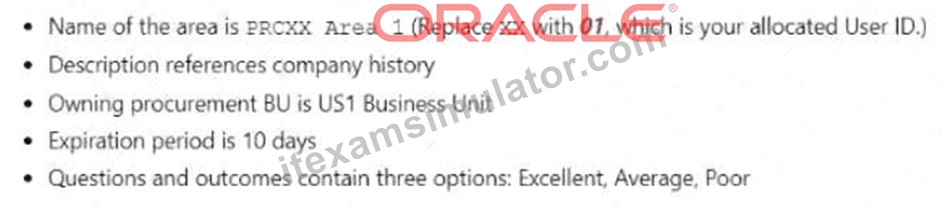
Answer:
Explanation:
See below in Explanation for each Step.
Explanation:
Task 6: Create a Qualification Question for Suppliers
Following the scenario, we need to create a new Qualification Question in Oracle Procurement Cloud named
"PRCXX Q1" (replace xx with 01) to assess potential suppliers' years in business.
Here are the steps to create the Qualification Question:
* Navigate to Manage Supplier Qualification Questions:
* Go to the Global Navigation Menu.
* Click on Procurement.
* Click on Setup and Maintenance.
* Click on Supplier Qualification.
* Click on Questions.
* Create the Qualification Question:
* Click on the Create icon (+ icon).
* Enter the Qualification Question Information:
* Name: Enter "PRCXX Q1" (replace xx with 01).
* Question Level: Select "Supplier".
* Responder Type: Select "Supplier".
* Question Type: Select "Multiple Choice - Single Select".
* Question Text: Enter "How many years have you been in business?".
* Required: (Optional) Select "Yes" if suppliers must answer this question.
* Active: Select "Yes" to activate the question.
* Define Acceptable Responses:
* Click on the Add icon (+ icon) to add new response options.
* Enter the following response options:
* 0
* 3
* 10
* Save the Qualification Question:
* Click on the Save button.
Verification:
* The Qualification Question "PRCXX Q1" (replace xx with 01) should now be listed in the Manage Supplier Qualification Questions page.
* You can verify the question details and acceptable responses by clicking on it.
* The question level, responder type, question type, text, required status, and active status should be displayed as specified above.
* The acceptable responses should include 0, 3, and 10 years.
Additional Notes:
* Make sure to replace "xx" with your allocated User ID (01) in the question name for consistent naming convention.
* Selecting "Multiple Choice - Single Select" limits suppliers to choosing one answer.
* You can add additional acceptable responses if needed.
* Activating the question makes it visible to suppliers during the qualification process.
NEW QUESTION # 48
In Sourcing, on which option is the ranking based when you set Overall Ranking Method to "Composite scoring"?
- A. Assess suppliers on both pricing and qualitative aspects.
- B. Assess suppliers on both pricing and supplier eligibility.
- C. Assess suppliers on both pricing and external cost factors.
- D. Assess suppliers on both pricing and internal cost factors.
Answer: A
Explanation:
When you set the Overall Ranking Method to Composite scoring, you can assess suppliers on both pricing and qualitative aspects. Qualitative aspects include requirements such as technical capabilities, other commercial considerations, or risk. You can assign weights to requirement sections, including pricing, and calculate a composite score for each supplier based on their response amount and requirement scores. The composite score is a combination of the relative score for pricing and the weighted requirement score. The higher the composite score, the higher the overall rank. This way, you can rank suppliers not just based on the best pricing offered, but also on how well they meet your requirements.
References:
Rank Suppliers Based on Composite Score of Pricing and Requirements1
Oracle Supplier Negotiations2
NEW QUESTION # 49
You should regularly run reports to protect against fraud.
Which task do you use to select the attributes to be monitored for a supplier model?
- A. Configure Procurement Business function
- B. Manage Audit Policies
- C. Configure Supplier Registration and Profile Change Request
- D. Manage Transmission Configurations
- E. Manage Common Options for Payables and Procurement
Answer: B
Explanation:
To select the attributes to be monitored for a supplier model, you use the Manage Audit Policies task in the Setup and Maintenance work area. This task allows you to enable auditing for various business objects, such as suppliers, supplier sites, supplier contacts, and supplier bank accounts. You can also select the attributes of each business object that you want to audit, such as supplier name, address, tax number, and so on. By enabling auditing, you can track the changes made to the supplier model and generate audit reports to protect against fraud.
:
Overview of Audit Configuration, Section 2.1: "Enable Auditing for Business Objects" Supplier Profile Audit History Setup and Reporting, Section 1: "Supplier Profile Audit History Setup and Reporting"
NEW QUESTION # 50
To improve usability and reduce errors, you have set a default negotiation template for each document type when creating or editing a negotiation style.
This feature is always enabled but you do not always see the template that was set on the negotiation style defaulting in.
What could be two reasons for this?
- A. It is a global template and the negotiation is created in the same BU as the template.
- B. The template is active at the time of creating the negotiation.
- C. The template is inactive at the time of creating the negotiation.
- D. It is a private template where only the template owner can use it.
- E. It is a public template.
Answer: C,D
Explanation:
The default negotiation template for each document type is only applied when creating or editing a negotiation style if the template is active and public. If the template is inactive or private, the template will not be defaulted in. Therefore, the two reasons why you do not always see the template that was set on the negotiation style defaulting in are:
* The template is inactive at the time of creating the negotiation. An inactive template cannot be used for creating or editing negotiations, and it will not be displayed in the list of available templates. You need to activate the template before you can use it as a default template.
* It is a private template where only the template owner can use it. A private template is only visible and accessible to the user who created it, and it will not be shared with other users. You need to make the template public if you want to use it as a default template for all users.
:
Create a Negotiation Template, section "Create a Negotiation Template", subsection "Default Negotiation Template".
Oracle Supplier Negotiations, section "Create Negotiations", subsection "Create Negotiations: Default Negotiation Template".
NEW QUESTION # 51
In the application, you can now view negotiation details for Purchase Orders and Purchase Agreements created as negotiation award outcomes.
Which tool should you use to make the field available?
- A. Workflow Composer
- B. Page Composer
- C. Application Composer
- D. Appearance Composer
- E. Structure Composer
Answer: B
Explanation:
Page Composer is a tool that you can use to customize the user interface of Oracle Fusion Cloud Procurement applications by adding, removing, or rearranging fields on pages. You can also modify the properties and styles of the fields, and add flex fields and hyperlinks. To make the negotiation details field available for Purchase Orders and Purchase Agreements, you can use Page Composer to edit the page layout and add the field from the source pane. You can also specify the conditions and expressions for displaying the field.
:
Modify the Requisitions Page Layout Using Page Composer, Section 1: "Modify the Requisitions Page Layout Using Page Composer" Page Composer, Section 1: "Page Composer"
NEW QUESTION # 52
uring discussions your client indicates that as they are a contract manufacturer, they need to execute supply chain activities in the context of projects.
In which offering can you opt in to a feature that enables this?
- A. Manufacturing and Supply Chain Materials Management
- B. Project Financial Management
- C. Project Execution Management
Answer: A
NEW QUESTION # 53
Your customer requires any approved requisition to be reapproved whenever a buyer updates a catalog requisition line during requisition processing.
How must they set this up?
- A. Configure the PO Approval rule in such a way that buyer-modified requisition lines will go for approval again.
- B. In the Configure Requisitioning Business Function task, select "Approval required for buyer modified lines".
- C. Configure a Requisition Approval rule to include the "Approval required for buyer modified lines'' condition.
- D. After requisition modification, a buyer needs to reassign the requisition line to the requisition authority for approval.
Answer: B
Explanation:
This option enables the customer to require any approved requisition to be reapproved whenever a buyer updates a catalog requisition line during requisition processing. This ensures that any changes made by the buyer are reviewed and approved by the appropriate authority before the requisition is converted to a purchase order.
:
Considerations for Setting Up Requisition Approval Task: This document explains the preconfigured requisition approval elements and how to configure requisition approval rules using the Manage Requisition Approvals task.
Overview of Managing Approvals and Notifications: This document provides an overview of the approval management framework and the approval rules management for procurement. It also describes the employee supervisor hierarchy approval rules and the user-defined attributes assignments and routing.
NEW QUESTION # 54
Challenge 2
Manage Business Unit
Scenario:
Your organization needs to establish a business unit to manage its procurement activities and assign it to the newly created purchasing location in Redwood City, CA.
Task 2
Create a new Business Unit for your purchasing organization, where you need to:
. Name the business unit as PRCXX Business Unit (Replace xx with 01, which is your allocated User ID.)
. Assign the location previously created
. Link to the USLOCS default set
Answer:
Explanation:
See below in Explanation for each Step.
Explanation:
To create a new Business Unit for your purchasing organization, you can follow these steps:
* Navigate to the Setup and Maintenance work area and search for the Manage Business Unit task.
* Click on the Go to Task icon to open the Manage Business Unit page.
* Click on the Create icon to create a new business unit.
* Enter the following information in the Create Business Unit dialog box:
* Name: PRC01 Business Unit
* Location: PRC01 Location
* Default Set: USLOCS
* Click on the Save and Close button to save the business unit.
You have successfully created a new business unit for your purchasing organization. You can verify the business unit details by searching for it in the Manage Business Unit page.
Or use the following Steps:
Following the scenario, we need to create a new Business Unit in Oracle Procurement Cloud for your purchasing organization and assign the previously created location in Redwood City, CA.
Here are the steps to create the Business Unit:
* Navigate to Manage Business Units:
* Go to the Global Navigation Menu.
* Click on Setup and Maintenance.
* Click on Business Units under Common Tasks.
* Create the Business Unit:
* Click on the Create icon (+ icon).
* Enter the Business Unit Information:
* Name: Enter "PRCXX Business Unit" (replace xx with 01).
* Default Location: Select "PRCXX Location" (replace xx with 01) from the dropdown list.
* Default Set: Select "USLOCS" from the dropdown list.
* Description: (Optional) Enter a brief description of the business unit.
* Save the Business Unit:
* Click on the Save button.
Verification:
* The Business Unit "PRCXX Business Unit" (replace xx with 01) should now be listed in the Manage Business Units page.
* You can verify the details of the business unit by clicking on it.
* The default location and set should be displayed as "PRCXX Location" (replace xx with 01) and
"USLOCS," respectively.
Additional Notes:
* Make sure to replace "xx" with your allocated User ID (01) in both the Business Unit name and code for consistent naming convention.
* Assigning the US Location Set to the Business Unit ensures that it inherits the legal entities, accounts, and other context information from that set.
NEW QUESTION # 55
Which two actions must you perform to implement and enable abstracts with negotiations?
- A. Create the abstract controls for the negotiation
- B. Create the Configure Abstract Listing page
- C. Create a negotiation style that supports abstracts
- D. Enable the suppliers to view the Abstract Listing page
- E. Create the negotiation controls to support abstracts
Answer: B,C
NEW QUESTION # 56
In Supplier Qualification management, your customer notices failures in the automatic qualification process.
Where should they look for further information to correct these?
- A. Automation Errors Infolet and Manage Automation Errors pages
- B. Automation Rules Infolet and Manage Automation Rules pages
- C. Supplier Registration Infolet and Manage Supplier Registration pages
- D. Supplier Qualifications Infolet and Manage Supplier Qualifications pages
Answer: A
NEW QUESTION # 57
Your client wishes to use amount-based line items when they are ordering a service, for example, they might order $5000 of consulting services over the next year.
Which two fields can be defaulted in from the purchase order line?
- A. Functional Area
- B. Category Name
- C. Unit of Measure (UOM)
- D. Catalog
- E. Context Prompt
Answer: B,C
NEW QUESTION # 58
For audit compliance, you require existing supplier bank account changes made by your Supplier Administrator to be approved.
Which step must you perform to fulfill this requirement?
- A. Configure Supplier Registration and Profile Change Request
- B. Manage Internal Supplier Profile Change Approvals
- C. Manage Internal Supplier Registration Approvals
Answer: B
NEW QUESTION # 59
Your client wants to be able to automate the process to ask employees to evaluate their suppliers periodically and enable a touchless process to track supplier performance over time.
Which feature do they need to opt in to?
- A. Sourcing Programs
- B. Full Supplier Profile Change Management
- C. Conduct Internal Surveys for Supplier Qualification
- D. Assess Supplier Eligibility for Sourcing
Answer: C
Explanation:
The feature that enables the automation of supplier evaluation by employees is Conduct Internal Surveys for Supplier Qualification. This feature allows you to create and publish internal surveys to collect feedback from employees who have interacted with suppliers. You can use predefined or custom questions, assign survey respondents, and schedule survey frequency. The survey responses are automatically captured and aggregated in the supplier qualification work area, where you can view the supplier performance scores and trends over time. This feature helps you to monitor and improve supplier performance, as well as identify potential risks and opportunities.
:
Conduct Internal Surveys for Supplier Qualification
How You Conduct Internal Surveys for Supplier Qualification
Oracle Fusion Cloud Procurement: Supplier Qualification
NEW QUESTION # 60
When you are creating your purchase orders, you want to be able to apply discounts to all purchase order lines with a single action and have opted in to the feature.
Which are the two conditions when the base price CANNOT be changed?
- A. The purchase order line is for catalog items.
- B. The purchase order line is received or billed, and the procurement business unit configuration does not allow manual price updates.
- C. The purchase order tine is created from a punchout marketplace that does not allow the price to be changed.
- D. The purchase order line is included on a Procurement Contract.
Answer: C,D
Explanation:
The base price of a purchase order line cannot be changed if the line is created from a punchout marketplace that does not allow the price to be changed, or if the line is included on a procurement contract. These are the two conditions that prevent the application of discounts to all purchase order lines with a single action.
:
Oracle Fusion Applications Procurement Implementation Guide, section "Purchase Order Pricing", subsection
"Price Change Conditions".
PRC:PO: Purchase Order Price Is Not Updated After A Change Order ..., section "Cause", subsection
"Solution".
NEW QUESTION # 61
......
Latest 1z0-1065-25 dumps - Instant Download PDF: https://torrentlabs.itexamsimulator.com/1z0-1065-25-brain-dumps.html
